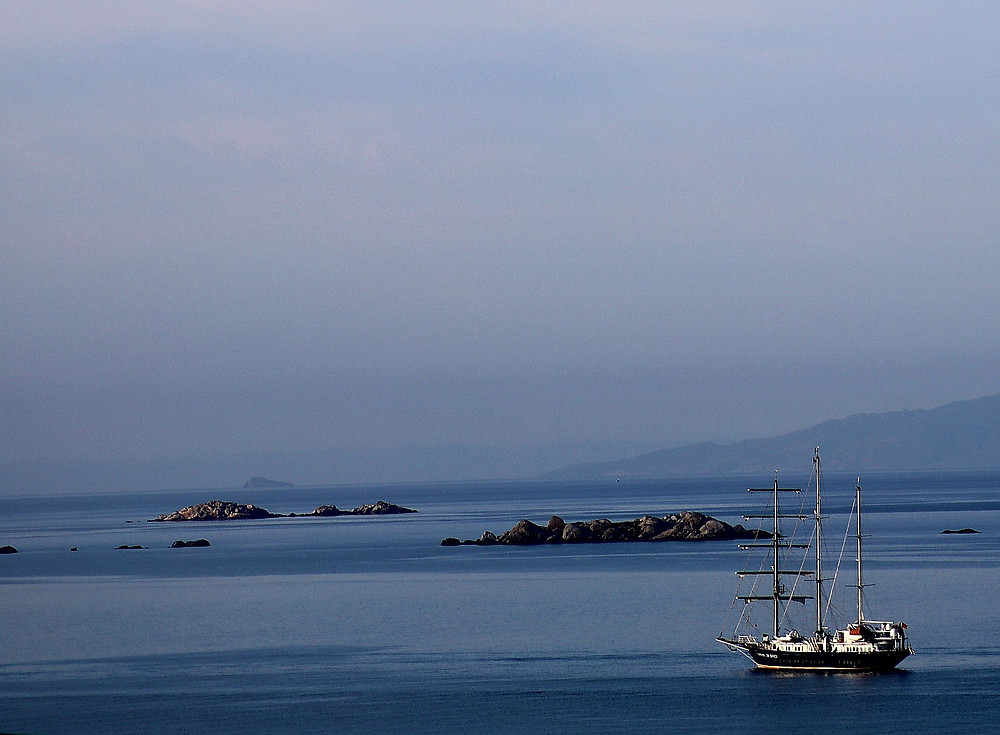
In La mer à l’envers (2019; English: The Sea Upside Down, 2024) by Marie Darrieussecq, two characters whose life paths could hardly be more different meet: Rose, a Parisian psychologist in her forties, and Younès, a young refugee from Niger. Their encounter takes place one night on the Mediterranean, somewhere between Italy and Libya. Rose, who is going through a personal crisis and seeking a break from her everyday life, has gone on a cruise with her children. Out at sea, she witnesses a rescue operation in which the cruise ship’s crew takes shipwrecked refugees on board.
The planned guest lecture focuses on this encounter between the two protagonists and examines it against the backdrop of the concept of ‘post-migration’. The term emerged in the early 2010s within the context of Berlin’s art and culture scene, where it established itself as a subversive and anti-racist approach that challenges traditional models of identity and categorisation (cf. Langhoff 2011). In the current academic debate, the term functions as an analytical perspective “that engages with social conflicts, narratives, identity politics, and social and political transformations that arise after migration has taken place, and that re-explores social relations beyond the socially established dividing line between migrants and non-migrants” (Foroutan 2018, p. 18). The post-migrant thus challenges conventional logics of difference and, at the same time, sees itself as a political perspective that encompasses subversive and, at times, ironic practices and acts upon hegemonic conditions.
The analysis of *La mer à l’envers* takes up this perspective. It is a migration novel written by an author with no personal experience of migration and told from the personal perspective of a protagonist who also bears autobiographical traits of the author. In parallel, Younès’s subsequent escape route is traced, leading him as far as Calais. A particular focus of the lecture is on the meeting between Rose and Younès, as well as on the narrative structure of this encounter. Central to this is the question of what topological function the Mediterranean Sea occupies in Marie Darrieussecq’s ‘post-migrant aesthetic’.